

About us

Solutions
Products
Content


Por
The period was marked by an improvement in the exchange rate, with the real strengthening against the dollar, albeit with some daily volatility. The external environment remained on investors' radar: the escalating conflict in the Middle East kept oil prices under pressure, while the market continues to calibrate expectations regarding the pace of interest rates in the United States under the new Federal Reserve management. Domestically, the new tariffs announced by the United States on Brazilian products—which take effect at the end of the month—caused some additional noise, but the exclusion of agribusiness items from the list helped soften the impact on local assets.
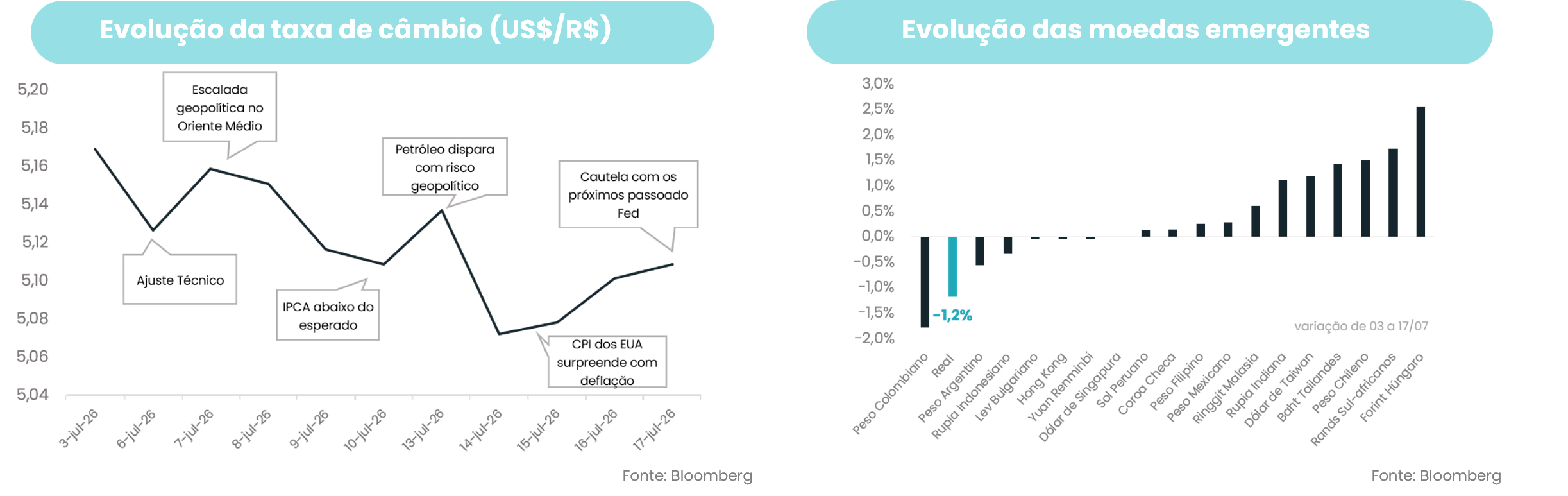
On the yield curve, activity data reinforces a reading of economic moderation in the second quarter. May retail sales came in below the bottom of market projections, signaling a cautious consumer and fueling hypotheses of a continued interest rate cut cycle. Along the same lines, the IBC-Br remained virtually flat in May, showing signs of losing momentum: the April result was revised downward (from 0.4%) and May's performance was weaker due to agriculture, which fell 1.0%, while industry and services grew only modestly. Over the 12-month period, the index rose 1.4%. Thus, the expectation remains that the Central Bank should maintain the Selic rate cut cycle in a slow and gradual manner. A movement that was reflected in the yield curve throughout this week.


A summary of the main events of each day that may influence the exchange rate, all in less than 1 minute.
Listen nowThe Ouribank Group does not offer loans, credit or debit cards, and does not request or take responsibility for payments of bank slips or deposits into current accounts held by beneficiaries other than Ouribank S.A. Banco Múltiplo and Ouribank Group companies.
Be alert to any unusual practices for credit approval, such as advance payments. Be suspicious of emails that do not come from Ouribank, for example: @outlook, @gmail, @hotmail, etc., or messages via WhatsApp, Facebook, Instagram, and Telegram, or calls from third parties.
If you have any questions, please contact us at: 0800-771-4342 or (11) 4081-4444


Ouribank
CNPJ No. 78,632,767/0001-20 Ouribank Building
Av. Paulista, No. 1,728 - overstore, 1st, 2nd, 3rd, 4th, 5th, 7th and 11th floors
Bela Vista Zip Code - 01310-919
São Paulo - SP
Phone: (11) 4081-4444
Hearing Impaired Care:
(11) 3171-3003
P
Tamer Comunicação Empresarial
+ 5511 99602-1317
Gustavo Girotto
gugirotto@tamer.com.br
Ana Carolina Saito ana.saito@tamer.com.br

Social Media


















.png)





































.png)
.png)

.png)
.png)
.png)
.png)
.png)
.png)
.png)
.png)
.png)
.png)
.png)
.png)
.webp)
.webp)
.webp)
.webp)
.webp)
.webp)
.webp)
.webp)
.webp)
.webp)

