About us

Solutions
Products
Content


Por
The year has barely begun, and the March rains are already here to close out the summer. And what rains they are! For those who believed we were in for a quieter year (myself included!)—at least until the start of the most critical period of the election cycle, which usually happens between August and October—the stars had something else in store for 2026. After a lukewarm start to the year, with the feeling that "nothing really starts until after Carnival," we arrived in March to a hurricane called the War in the Middle East. Once again, economists have been forced to humble themselves and recalibrate their projections. With that in mind, what could be the main impacts of this conflict on Brazil's economy, and what should we expect for the key variables moving forward?
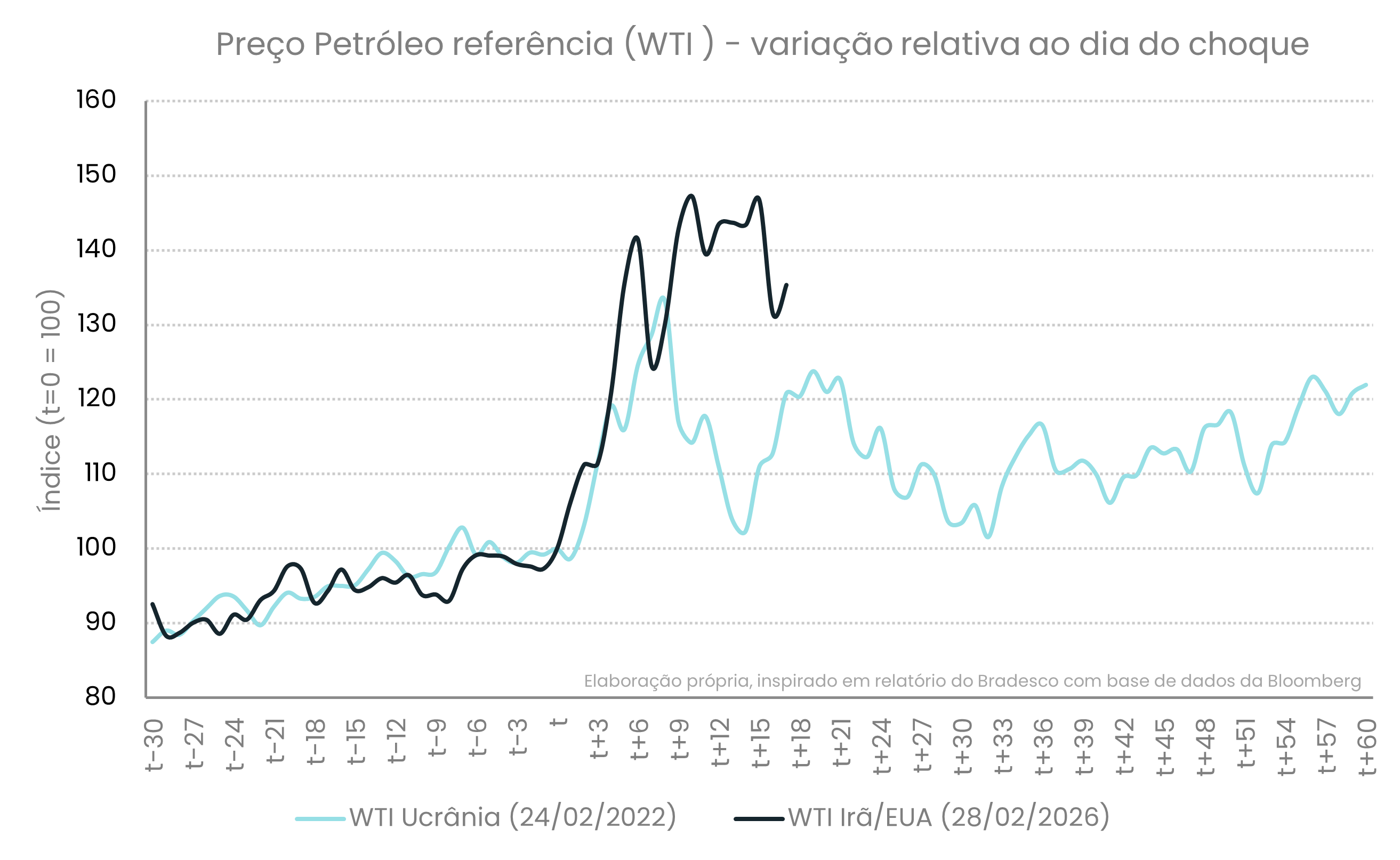
Following the actions between the US and Iran, the price of oil surged by about 40%, marking the first and most visible impact on economic projections. It is worth noting that this recent movement was, once again, a reflection of a geopolitical shock associated with global supply constraints for the commodity. Moreover, the movement was at times greater than what was observed in 2022 during Russia's invasion of Ukraine (see chart). Just as in that episode, the rise in prices was accompanied by a strengthening of the dollar on the international stage, indicating a typical dynamic of risk aversion and a flight to safety. This type of shock tends to generate effects that go beyond a one-off price adjustment, with the potential to persist and influence relevant macroeconomic variables in both the global environment and emerging economies like Brazil. We have listed the variables that may have (and already have had) the greatest impacts below:
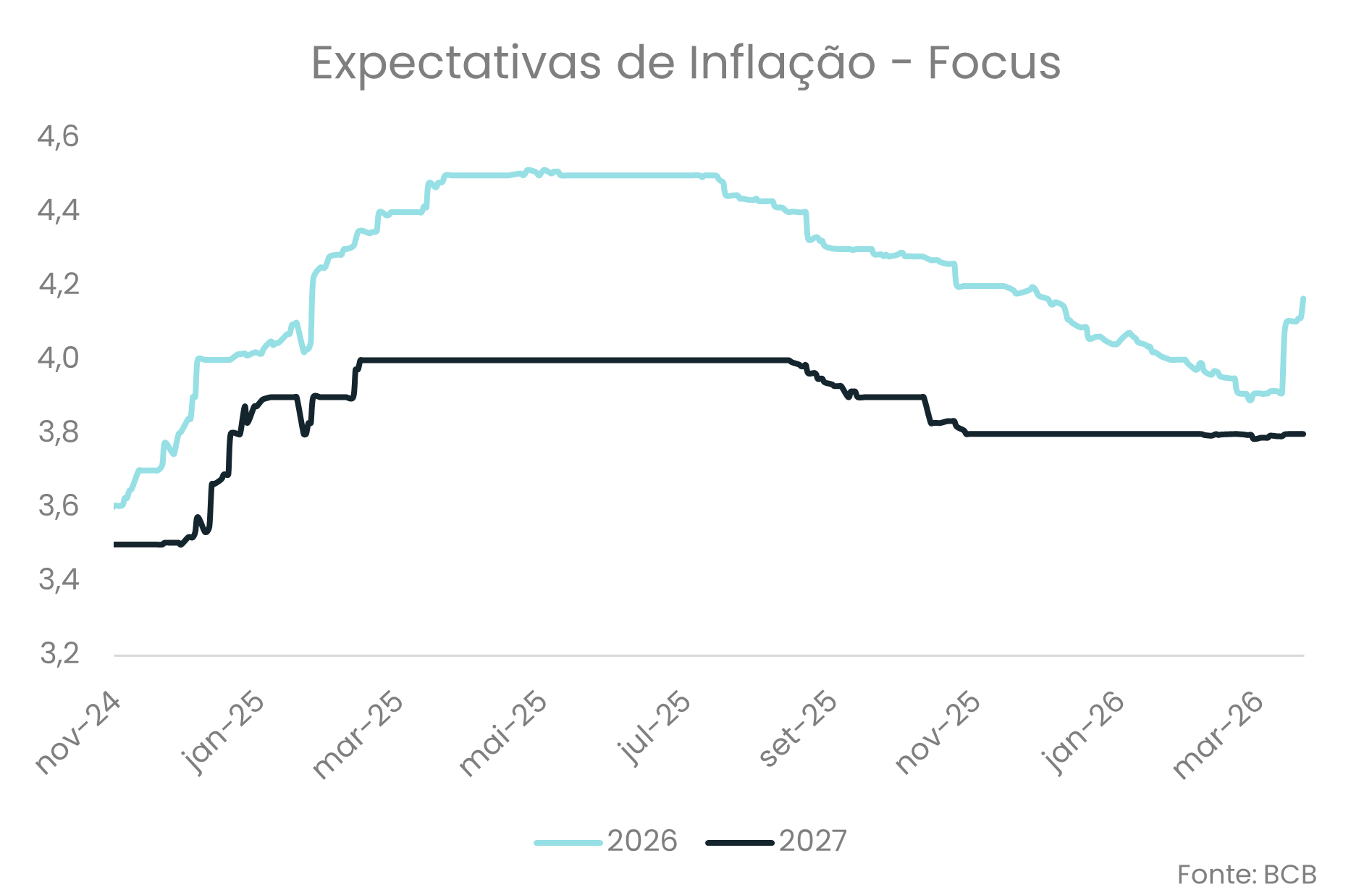
Let's start with inflation: The rise in oil prices directly affects fuel costs—especially gasoline and diesel, which carry significant weight in inflation indicators. Furthermore, there is a major indirect, chain-reaction effect, as higher diesel prices, for example, pressure freight transport costs, contaminating the prices of food, industrial goods, and services. This pass-through tends to be gradual, but at times, it can be persistent. This threatens to hinder or reverse the disinflation process and may de-anchor expectations, which is exactly what we are seeing in more recent inflation projections for Brazil (see chart).
So, what does this mean for interest rates? Faced with more widespread and potentially persistent inflationary pressure, the monetary authority tends to adopt a more cautious stance—just as we saw in the minutes released last Tuesday. This implies less room for further Selic rate cuts or, in a more adverse scenario, the need to pause the easing cycle for longer. The Central Bank is also beginning to monitor secondary effects on inflation expectations and economic activity more closely, which could result in a steeper yield curve, particularly at the longer end—meaning that long-term interest rates would be higher compared to short-term ones.
Looking at the external scenario, the impact tends to be generally positive in the short term, given that Brazil is a net oil exporter and benefits from higher commodity prices, which improves the terms of trade and supports foreign currency inflows. However, this effect may be partially offset by the increased cost of importing refined products and, primarily, by a potential cooling of the global economy—should the oil shock lead to tighter financial conditions, which would reduce demand for Brazilian exports. Even so, it is too early to say whether this scenario will actually materialize; for now, we assess that the impact on the external sector tends to be more neutral.
And what about the exchange rate in this scenario? Exchange rate behavior tends to fluctuate amidst these "opposing forces." On one hand, improved terms of trade and higher dollar inflows from exports favor the appreciation of the real. On the other, increased global uncertainty leads to a flight to safer assets, which strengthens the dollar. Furthermore, episodes of heightened risk aversion usually trigger capital outflows from emerging economies and additional depreciation of their currencies, regardless of whether domestic fundamentals are stronger or not. Thus, the net result depends on the balance of risks between more favorable external fundamentals and a potentially more risk-averse global environment.
Finally, and no less importantly, the March rains have arrived to end the summer and scramble our projections. Faced with such a challenging environment, the reading is one of an economy in "delicate balance," with stubborn inflation, still-restrictive monetary policy, lackluster economic activity, and a high exchange rate, all within an environment that remains highly dependent on the external scenario but could change at any moment if the war context ends in the short term!

A summary of the main events of each day that may influence the exchange rate, all in less than 1 minute.
Listen nowThe Ouribank Group does not offer loans, credit or debit cards, and does not request or take responsibility for payments of bank slips or deposits into current accounts held by beneficiaries other than Ouribank S.A. Banco Múltiplo and Ouribank Group companies.
Be alert to any unusual practices for credit approval, such as advance payments. Be suspicious of emails that do not come from Ouribank, for example: @outlook, @gmail, @hotmail, etc., or messages via WhatsApp, Facebook, Instagram, and Telegram, or calls from third parties.
If you have any questions, please contact us at: 0800-771-4342 or (11) 4081-4444


Ouribank
CNPJ No. 78,632,767/0001-20
Ouribank Building
Av. Paulista, No. 1,728 - overstore, 1st, 2nd, 3rd, 4th, 5th, 7th and 11th floors
Bela Vista Zip Code - 01310-919
São Paulo - SP
Phone: (11) 4081-4444
Hearing Impaired Care:
(11) 3171-3003
P
Tamer Comunicação Empresarial
+ 5511 99602-1317
Gustavo Girotto
gugirotto@tamer.com.br
Ana Carolina Saito ana.saito@tamer.com.br

Social Media