About us

Solutions
Products
Content


Por
Add a pinch of inflation, two spoonfuls of interest rates, half a cup of depreciated exchange rate, salt to taste, and see where economic growth heads! The recipe isn't exact, and the dish doesn't always turn out as planned, as it depends heavily on who is mixing the ingredients and how well they bind together. But the fact is, when we talk about economic growth, we look far beyond the GDP, which is released quarterly by the IBGE. To understand the dynamics of economic activity, it is essential to track higher-frequency indicators that capture the economy's pace over shorter periods and help anticipate trends. Industrial production levels, the monthly retail survey, the services survey, the famous and important Central Bank economic activity indicator (IBC-Br), and the GDP projections released in the Focus Report are just a few of the indicators that make up this mosaic, offering a more detailed view of the landscape. Analyzing this data allows us to understand if the amount of ingredients is sufficient or if some adjustments to the recipe are needed!
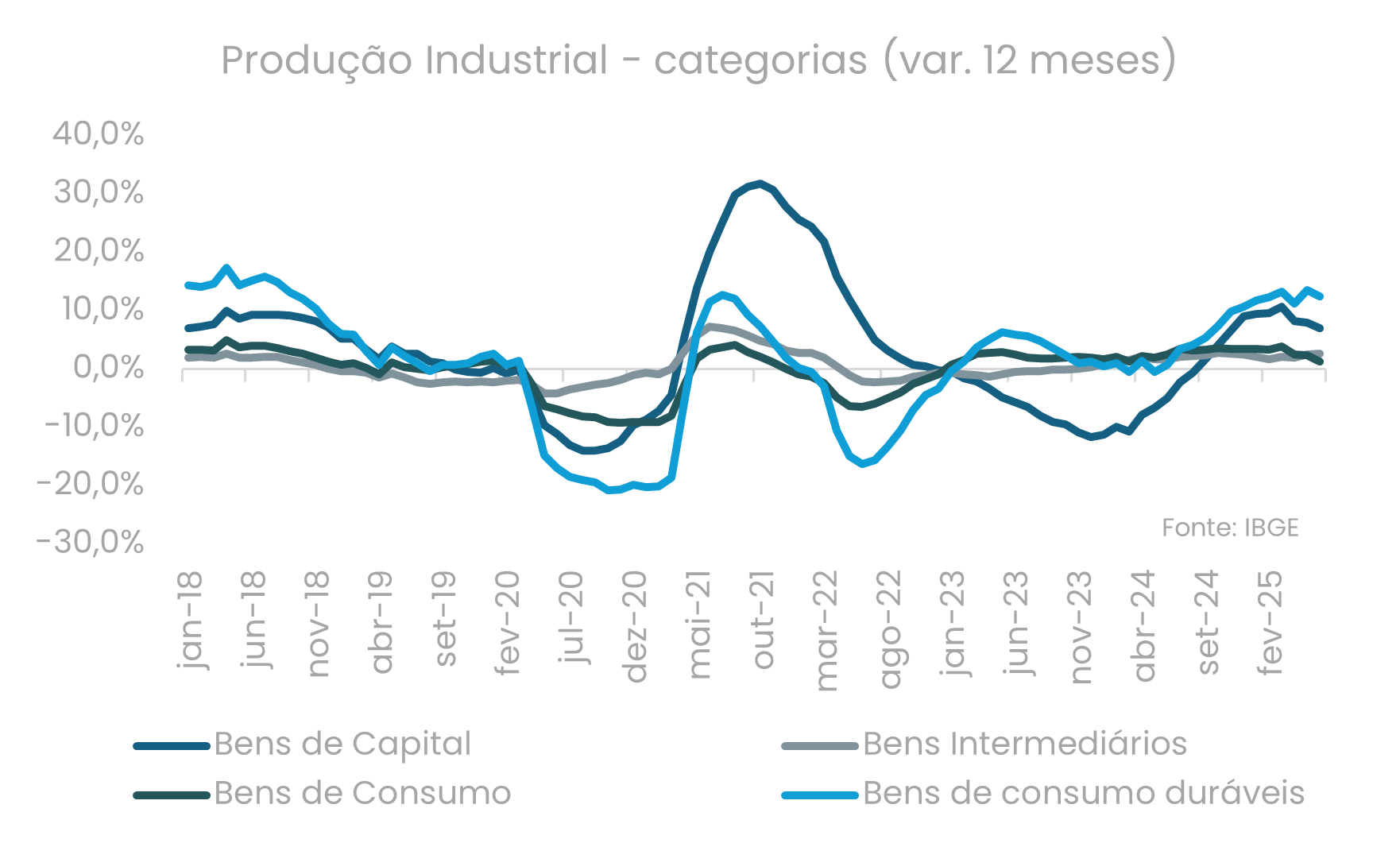
Starting with one of the bitterest ingredients in our recipe: industry, the sector that suffers from high interest rates and expensive credit. The most recent data shows a sector that has yet to find traction for a consistent growth cycle. We have seen some isolated progress in segments linked to capital goods, suggesting some optimism regarding future investments, but performance remains uneven. The production of durable consumer goods (products manufactured for final household consumption with a long useful life), for example, remains sensitive to the cost of credit, while intermediate goods (used as inputs in the production of other goods or services) are suffering from weaker global demand (see chart). This combination means the industrial sector, historically important for overall economic growth, plays a more limited role in the current recovery.
On the other hand, the most popular ingredient that whets the population's appetite—the retail sector—presents a slightly more favorable picture, supported by a heated labor market and the recent slowdown in inflation, which preserves part of household purchasing power (see chart). Essential goods segments, such as supermarkets, and categories linked to personal services have maintained a positive pace. However, sectors dependent on credit, such as home appliances and vehicles, continue to face a challenging environment, reflecting still-high interest rates and consumer caution. Thus, although retail sales are contributing to overall economic growth, perhaps a pinch more of this ingredient is needed to add the flavor and strength required to accelerate activity more broadly.

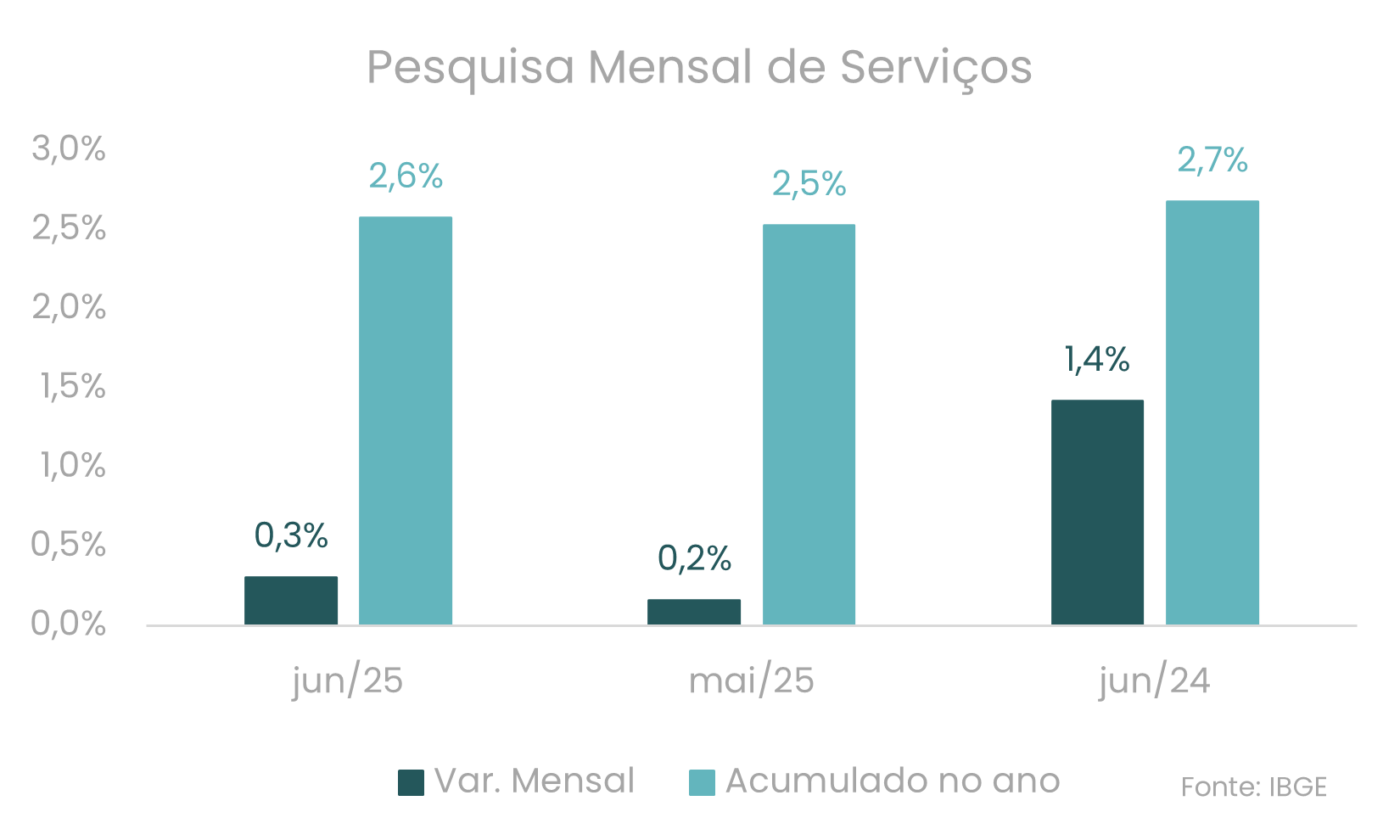
The chocolate sauce on our cake—or rather, the services sector, which accounts for more than 70% of GDP—remains the main engine of the Brazilian economy and is also the ingredient responsible for keeping inflation above target. Activities linked to information technology, business services, and tourism continue to show expansion, albeit with signs of slowing down compared to previous quarters. This cooling off is natural after the strong growth observed post-pandemic (who doesn't get tired of eating chocolate every day, right? – not me!), but it still keeps services in positive territory and with enough weight to sustain the level of activity (see chart), partially offsetting our blander ingredient: industry.
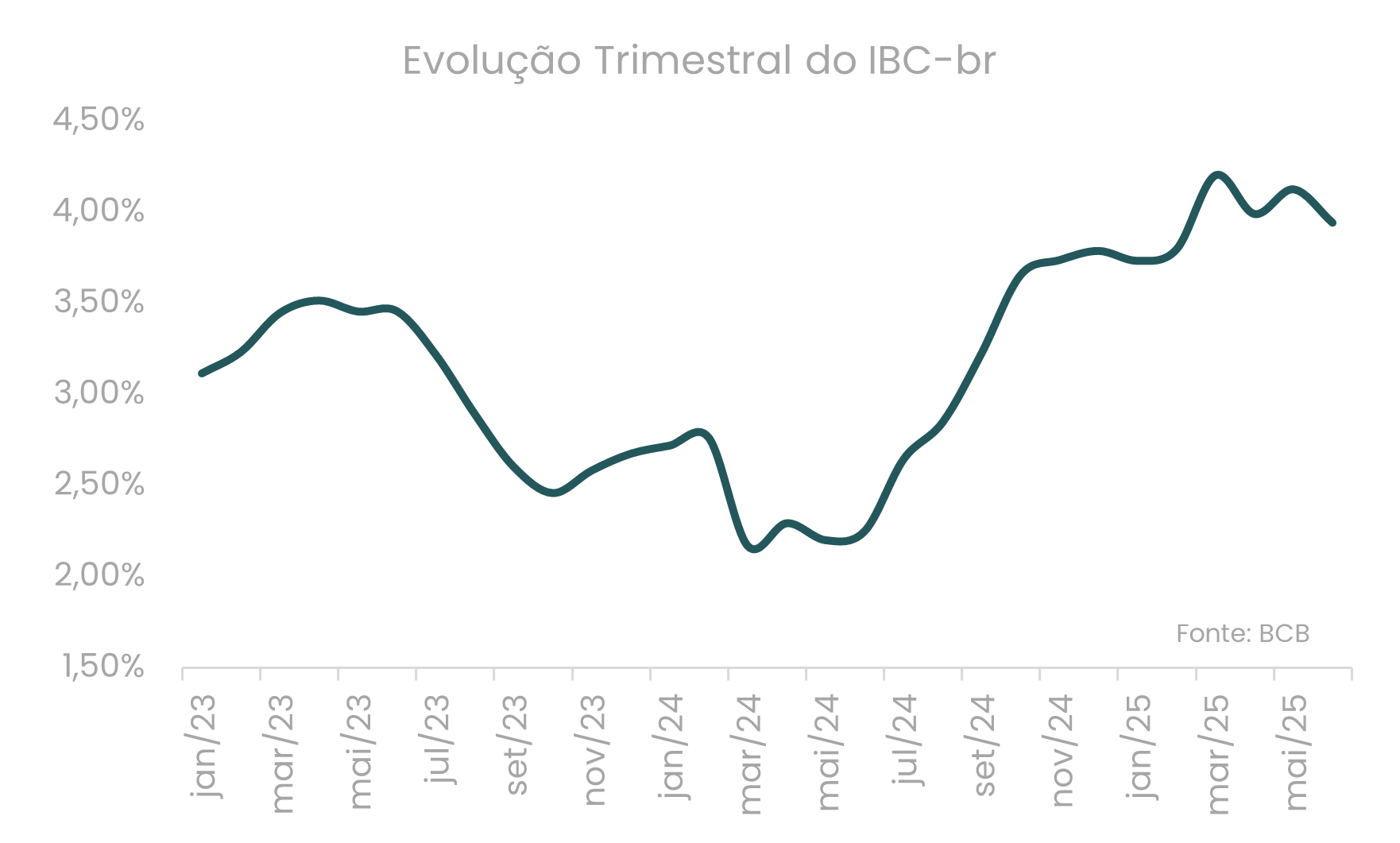
Put it all together, mix it up, add a little baking powder and a few other things, and there you have it: our favorite, the IBC-Br, or the monthly GDP preview. For those who don't know, the IBC-Br is an economic activity indicator released monthly by the Central Bank and is considered a proxy for GDP. The index has shown fluctuations in recent months, reflecting the exact contrast between the strength of services and the instability of industry and retail. The latest release pointed to moderate growth (see chart), signaling that the economy is not in contraction but should advance at a more contained pace in the second half of the year, especially given the still-restrictive monetary policy and a less favorable external scenario. So, what do you think? Will this recipe work out in the end?
The expectations captured by the Focus Report corroborate the view pointed out by the IBC-Br. After some upward revisions at the beginning of the year, GDP projections have stabilized at a slightly lower level, with analysts indicating more modest growth for the coming quarters. The perception is that, without new stimuli or a faster drop in interest rates, the economy tends to lose steam gradually, heading toward a scenario of moderate growth but without imminent risks of recession. In other words, we aren't saying the cake won't rise, but perhaps it needs a bit more baking powder to finish this recipe.
Conclusion: at the end of the day, the economic growth recipe seems set to continue on low heat, requiring patience and attention to the quantity and quality of the ingredients. High-frequency data is important for monitoring whether the mixture is right, thus preventing the cake from falling. However, the current reading indicates that without more significant interest rate cuts or a more favorable external boost, we are unlikely to see exuberant and sustainable economic growth in the short term. So, the cake will come out of the oven, yes, but likely with a milder flavor than desired—and it will be up to economic policy to decide whether it just wants to keep the dough rising or if it will dare to add new spices to accelerate the final result.

A summary of the main events of each day that may influence the exchange rate, all in less than 1 minute.
Listen nowThe Ouribank Group does not offer loans, credit or debit cards, and does not request or take responsibility for payments of bank slips or deposits into current accounts held by beneficiaries other than Ouribank S.A. Banco Múltiplo and Ouribank Group companies.
Be alert to any unusual practices for credit approval, such as advance payments. Be suspicious of emails that do not come from Ouribank, for example: @outlook, @gmail, @hotmail, etc., or messages via WhatsApp, Facebook, Instagram, and Telegram, or calls from third parties.
If you have any questions, please contact us at: 0800-771-4342 or (11) 4081-4444


Ouribank
CNPJ No. 78,632,767/0001-20 Ouribank Building
Av. Paulista, No. 1,728 - overstore, 1st, 2nd, 3rd, 4th, 5th, 7th and 11th floors
Bela Vista Zip Code - 01310-919
São Paulo - SP
Phone: (11) 4081-4444
Hearing Impaired Care:
(11) 3171-3003
P
Tamer Comunicação Empresarial
+ 5511 99602-1317
Gustavo Girotto
gugirotto@tamer.com.br
Ana Carolina Saito ana.saito@tamer.com.br

Social Media