About us

Solutions
Products
Content


Por
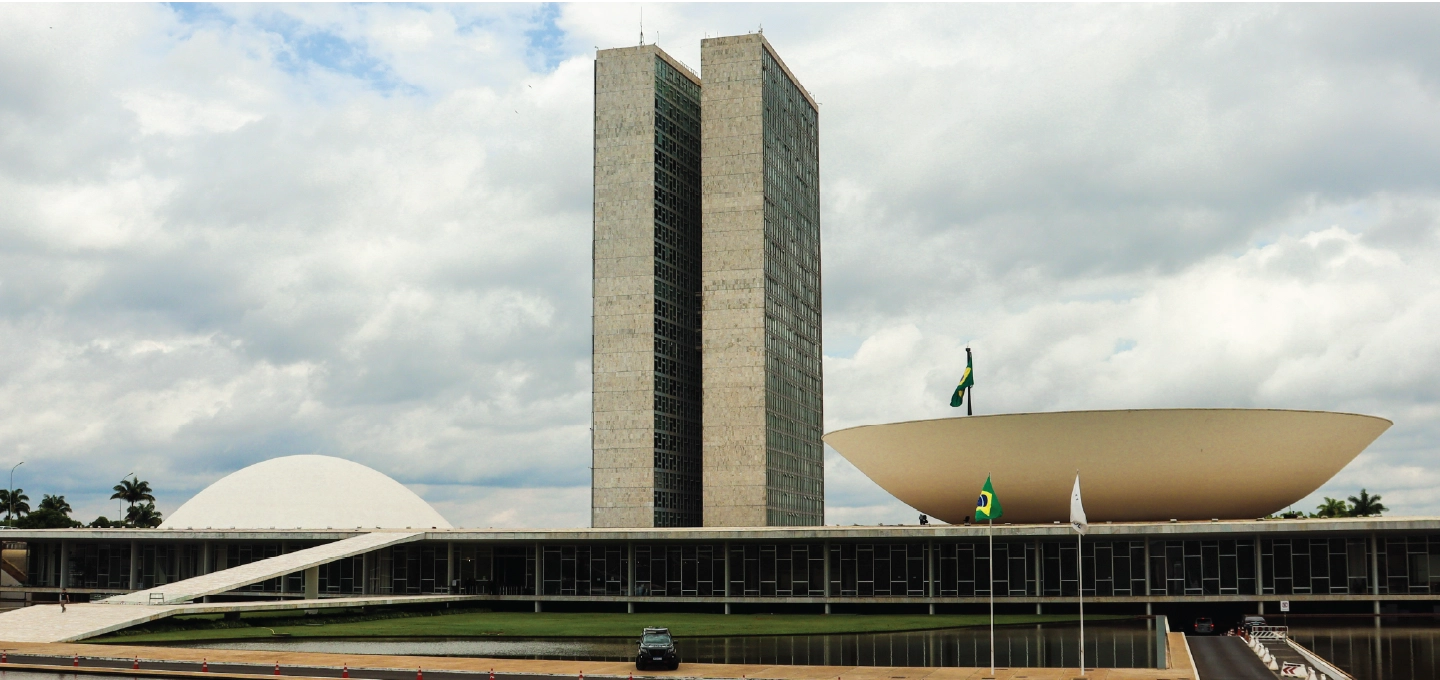
Carnival is just around the corner, and there’s only one thing on everyone’s mind: who’s going to win the parade this year? Well, that would be nice, but in the financial markets, the story is quite different. The theme song of the moment is: where are interest rates headed in 2026? Indeed, as Carnival approaches, the country enters that familiar period where the economy slows down in the short term, but medium- and long-term planning continues to demand extra attention. In monetary policy, the scenario is no different. After an intense tightening cycle, the Central Bank is beginning its dress rehearsal for a new interest rate regime, with 2026 emerging as the year that consolidates a lower Selic rate—even if we are still far from a truly expansionary environment. Now, what everyone wants to know is how the show will be conducted throughout the year. Shall we see?
Make way...
In this parade, inflation indicators follow the rhythm of the drums that dictate the movement of interest rates. The market, in turn, acts as the lead section, anticipating moves and adjusting expectations based on inflation data, economic activity, and the external environment. Meanwhile, fiscal policy remains the heaviest float: imposing, unavoidable, and capable of compromising the harmony of the parade if it gets out of sync. Just like on the avenue, where excessive improvisation usually costs points, conducting monetary policy in 2026 requires fine coordination, predictability, and discipline. The Central Bank’s challenge will be to cross the avenue of the easing cycle without missing a beat, preventing political noise, localized inflationary pressures, or external shocks from disrupting a parade that, so far, is starting to take shape. This report analyzes the factors that will dictate the pace of rate cuts and the risks capable of turning a well-rehearsed parade into a turbulent crossing.
Let inflation pass by...
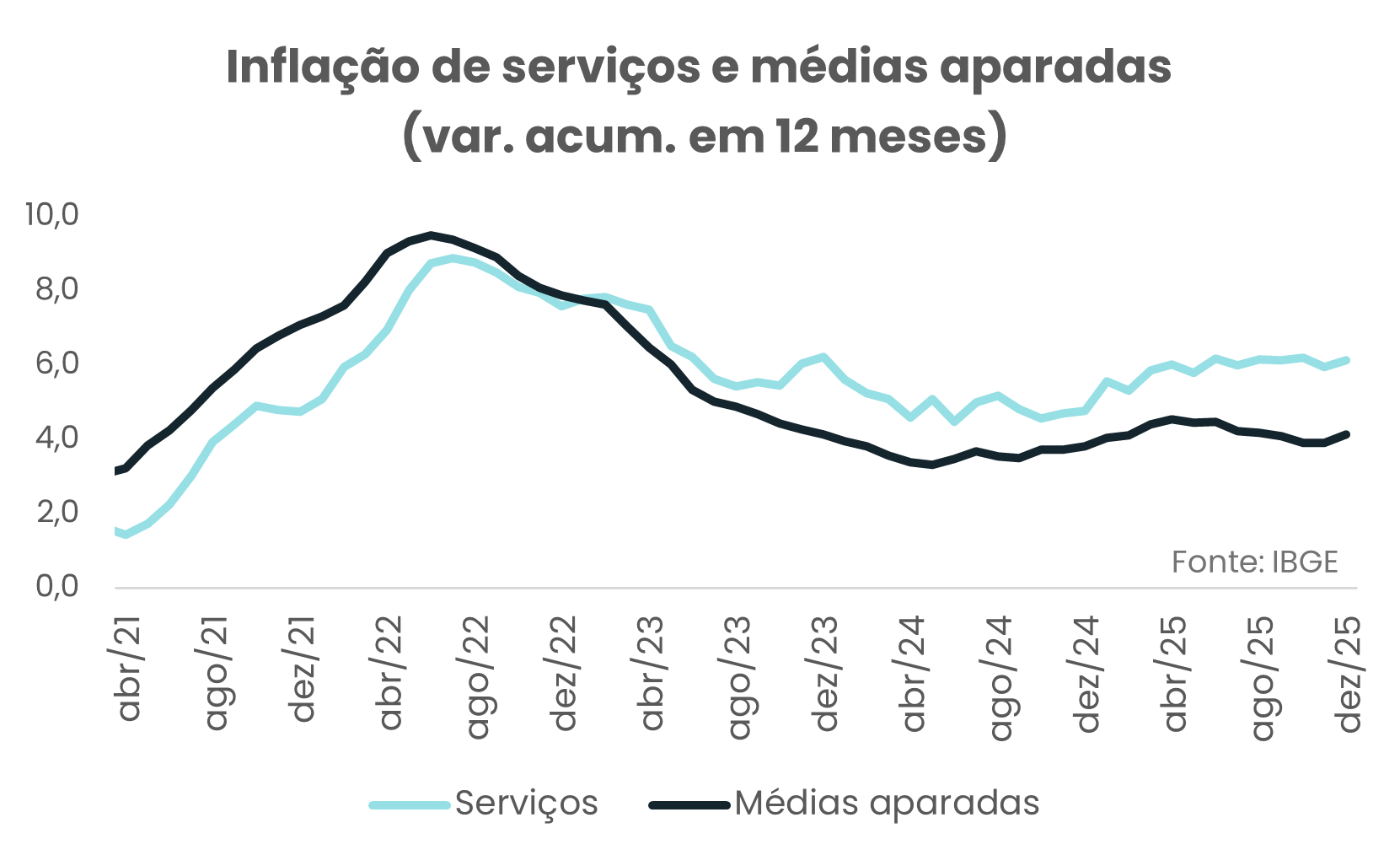
In the inflation section, the drums are finally playing a more measured beat: the latest data and projections show that inflationary pressures are losing steam, creating room for the monetary policy parade to gain some lightness. Recent data show a gradual deceleration in prices, the result of activity losing momentum, the cumulative effect of high interest rates, and the dissipation of past, noisier shocks, such as a more pressured exchange rate. Core inflation is moving with more composure down the avenue, while services insist on dancing to a still-accelerated rhythm (see chart), demanding the attention of the monetary policy conductor. In the latest Focus Report, the median expectation for the 2026 IPCA fell a little further to 3.99%, still above the target midpoint, but marking the fourth consecutive week of downward revisions—a truly favorable theme song in terms of prices. This downward trend in expectations, which are beginning to approach a more serene tempo, reinforces the confidence that, throughout the year, inflation will be able to follow the softer steps of the drums, giving the Central Bank room to conduct a gradual easing of the Selic rate without any stumbles—a plot where prices parade more calmly and expectations seem to be following the path toward the target.
How long will GDP keep moving...
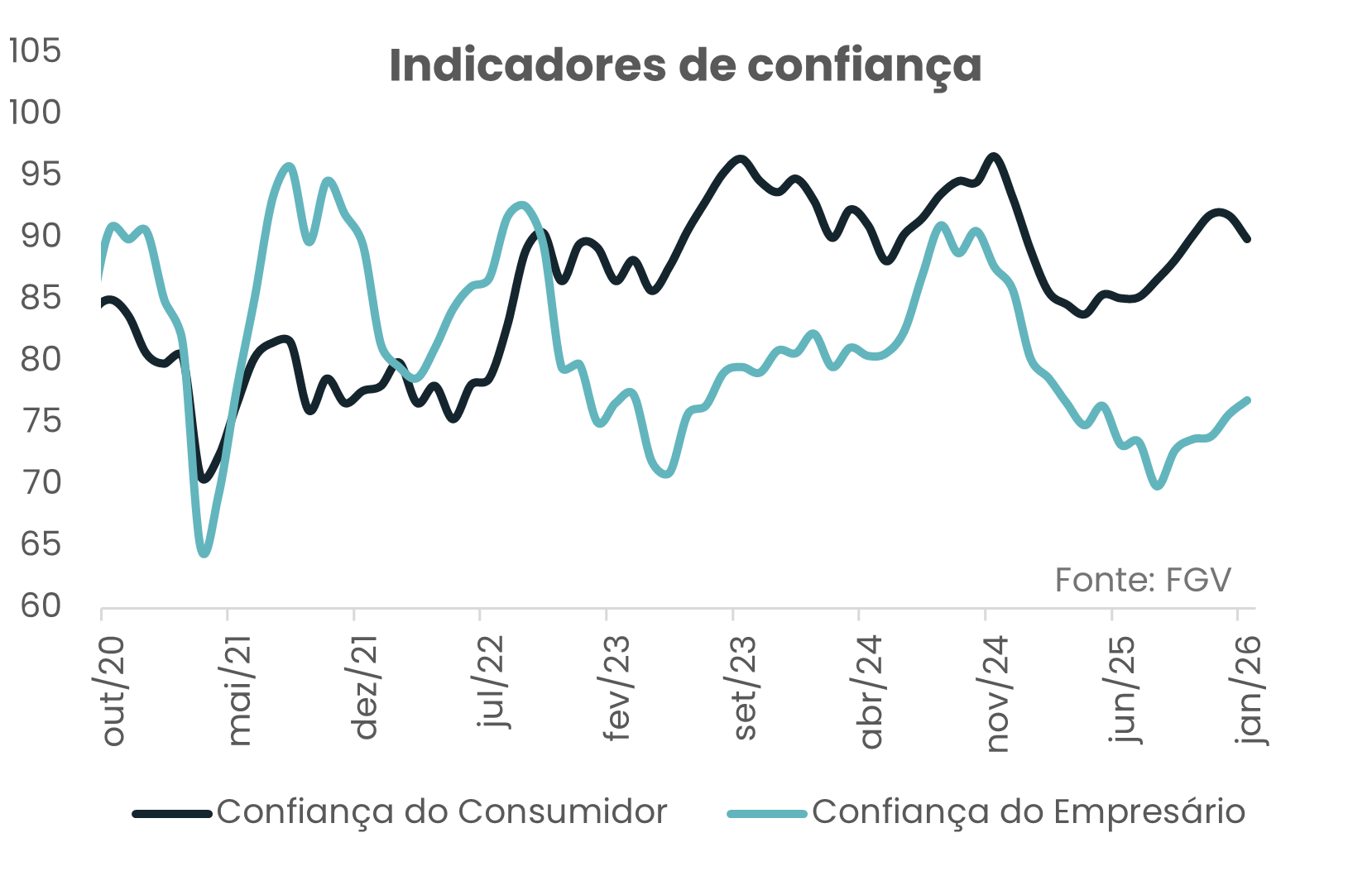
In the economic activity sector, the parade is also underway, though not all the choreographic groups are following the same step. Brazil entered the avenue with moderate growth: projections indicate that GDP should grow by about 2.3% in 2025 (the final figure will be known in early March) and slow to around 1.6%–1.8% in 2026, following slightly better data in previous years. This reflects a demand environment that remains resilient, even under the influence of a more restrictive monetary policy and external winds blowing in various directions. In the confidence VIP box, consumers are starting to get a bit more excited and are risking a less restrained performance. Driven by the deceleration of inflation, consumer confidence has shown recent improvement, according to FGV data, like someone watching the drums and getting ready to finally join the dance. The business sector, however, remains more restrained in recent surveys, reflecting caution and a lack of enthusiasm—like a technically correct parade that is still far from thrilling the stands (see chart). Thus, in the great ball of the economy, the plot of activity is moving in a middle ground: it continues to grow, but with measured steps—a rhythm that will heavily influence expectations for the trajectory of the Selic rate in 2026.
And speaking of winds from abroad, they arrived in full force in 2026...
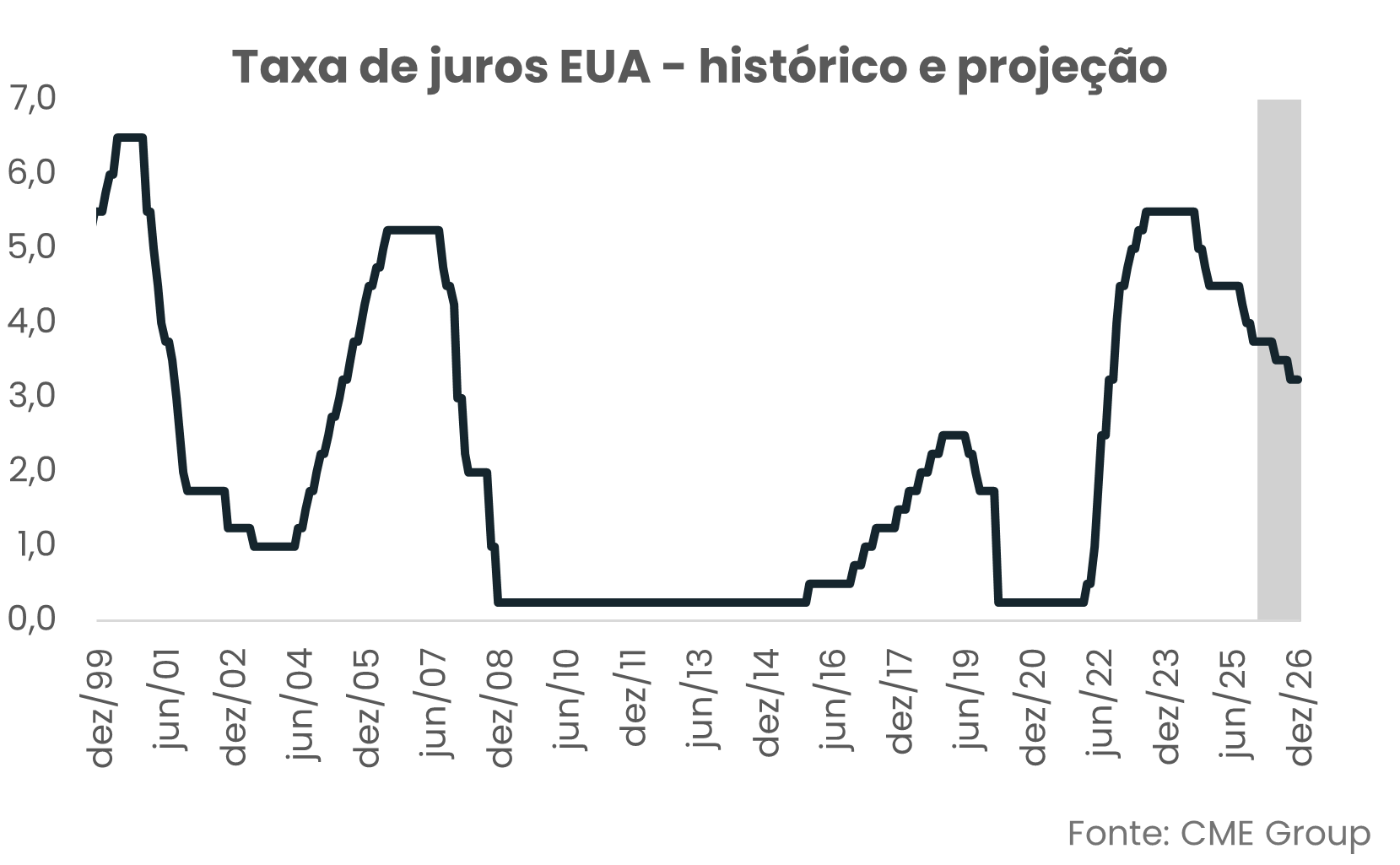
On the international stage, the parade remains unpredictable, with sections struggling to stay in time. Geopolitical tensions continue to stir things up behind the scenes—conflicts in the Middle East, the ongoing war in Eastern Europe, and an increasingly fragmented geopolitical landscape keep risk premiums high and the market on permanent alert. Meanwhile, the American beat sets the pace for the largest section. The Federal Reserve is marching with caution, signaling gradual, data-dependent rate cuts following a cycle of tighter monetary policy. U.S. interest rates are expected to fall throughout 2026 (see chart), but at a slower tempo than some in the market had hoped, keeping global financial conditions relatively tight. For emerging economies like Brazil, this acts as an additional drag: it limits the room for faster Selic rate cuts, influences the dollar, and requires the Central Bank to march with extra care to avoid losing points on credibility. In short, the international samba isn't completely out of tune, but it isn't exactly hitting its stride either—and in this global Carnival, staying on the right beat matters more than rushing the tempo.
At the end of the avenue, the final assessment points to a less exuberant performance, but one that is technically well-executed. The combination of slowing inflation, cooling economic activity, and a still-demanding external environment supports the narrative that the Selic rate should indeed continue its downward trajectory in 2026—but without any unnecessary flair or overly ambitious steps. The Central Bank enters the final stretch of the parade with room to cut rates slowly and gradually (the Focus projection is for the Selic to end the year at 12.25%), adjusting each move to new data while keeping a close eye on price behavior, economic activity, and, above all, the weight of the fiscal float. The biggest risk isn't missing a step due to excessive caution, but rather giving in to the temptation to speed up beyond the pace set by the rhythm section. Ultimately, the 2026 interest rate Carnival is likely to be less about euphoria and more about technique—a transitional performance where earning points for credibility is worth more than drawing momentary applause from the stands.

A summary of the main events of each day that may influence the exchange rate, all in less than 1 minute.
Listen nowThe Ouribank Group does not offer loans, credit or debit cards, and does not request or take responsibility for payments of bank slips or deposits into current accounts held by beneficiaries other than Ouribank S.A. Banco Múltiplo and Ouribank Group companies.
Be alert to any unusual practices for credit approval, such as advance payments. Be suspicious of emails that do not come from Ouribank, for example: @outlook, @gmail, @hotmail, etc., or messages via WhatsApp, Facebook, Instagram, and Telegram, or calls from third parties.
If you have any questions, please contact us at: 0800-771-4342 or (11) 4081-4444


Ouribank
CNPJ No. 78,632,767/0001-20
Ouribank Building
Av. Paulista, No. 1,728 - overstore, 1st, 2nd, 3rd, 4th, 5th, 7th and 11th floors
Bela Vista Zip Code - 01310-919
São Paulo - SP
Phone: (11) 4081-4444
Hearing Impaired Care:
(11) 3171-3003
P
Tamer Comunicação Empresarial
+ 5511 99602-1317
Gustavo Girotto
gugirotto@tamer.com.br
Ana Carolina Saito ana.saito@tamer.com.br

Social Media