About us

Solutions
Products
Content


Por
In times of uncertainty, confidence tends to shift like the wind, changing direction at the slightest sign of instability. The current global landscape is a portrait of this: a mix of frustrated expectations, geopolitical risks, and unpredictable economic policies. In the United States, for example, trade policy and the debate over the direction of interest rates create waves of volatility that ripple across the rest of the world. In Europe, the expectation of low growth coexists with doubts about the future of countries in perpetual conflict. And in Brazil, fiscal and electoral uncertainties complete a picture that challenges even the most experienced analysts. In this context, confidence indicators seem to lose their rhythm: at times reflecting hope for future improvement, at others translating the discomfort of a lack of visibility. More than just measuring optimism or pessimism, today they capture the volatile mood of a world trying to understand where it is heading.
Speaking specifically about Brazil, we cannot say we are in a completely catastrophic scenario—far from it—but we also don't see a bed of roses ahead. As the saying goes, it’s neither one extreme nor the other. There are still many issues to be addressed (hello, fiscal policy!) and the approaching electoral calendar adds an extra ingredient of tension and expectation. Confidence indicators show an environment that is somewhat peculiar and uncertain. While consumer confidence shows a significant improvement in the most recent data, business confidence still leaves something to be desired (see chart). The recent slowdown in inflation played a relevant role in improving the perception of families, who have begun to feel a bit more secure about spending. On the business side, however, despite the progress—albeit modest—of some structural reforms, uncertainties such as the fiscal scenario regarding whether or not the surplus target will be met, in addition to record-high interest rates, sustain a less optimistic outlook.

However, it is worth noting that according to an Ipsos survey, Brazil currently ranks among the ten countries with the highest level of consumer confidence out of the 30 countries analyzed, maintaining a prominent position and performance above the global average (see chart). In September of this year, the Brazilian Consumer Confidence Index (CCI), calculated by the institution, recorded a slight rise, advancing to 51.7 points and keeping the country close to the neutrality line (50). According to Ipsos, this result reflects a still-heated labor market with a low unemployment rate and a greater sense of financial security (with inflation helping here). Despite this, confidence remains marked by caution, with no relevant change in the general perception of the economy, as the global index remains stable at 48 points—practically the same level observed in August of last year, when we wrote a report on these indicators.

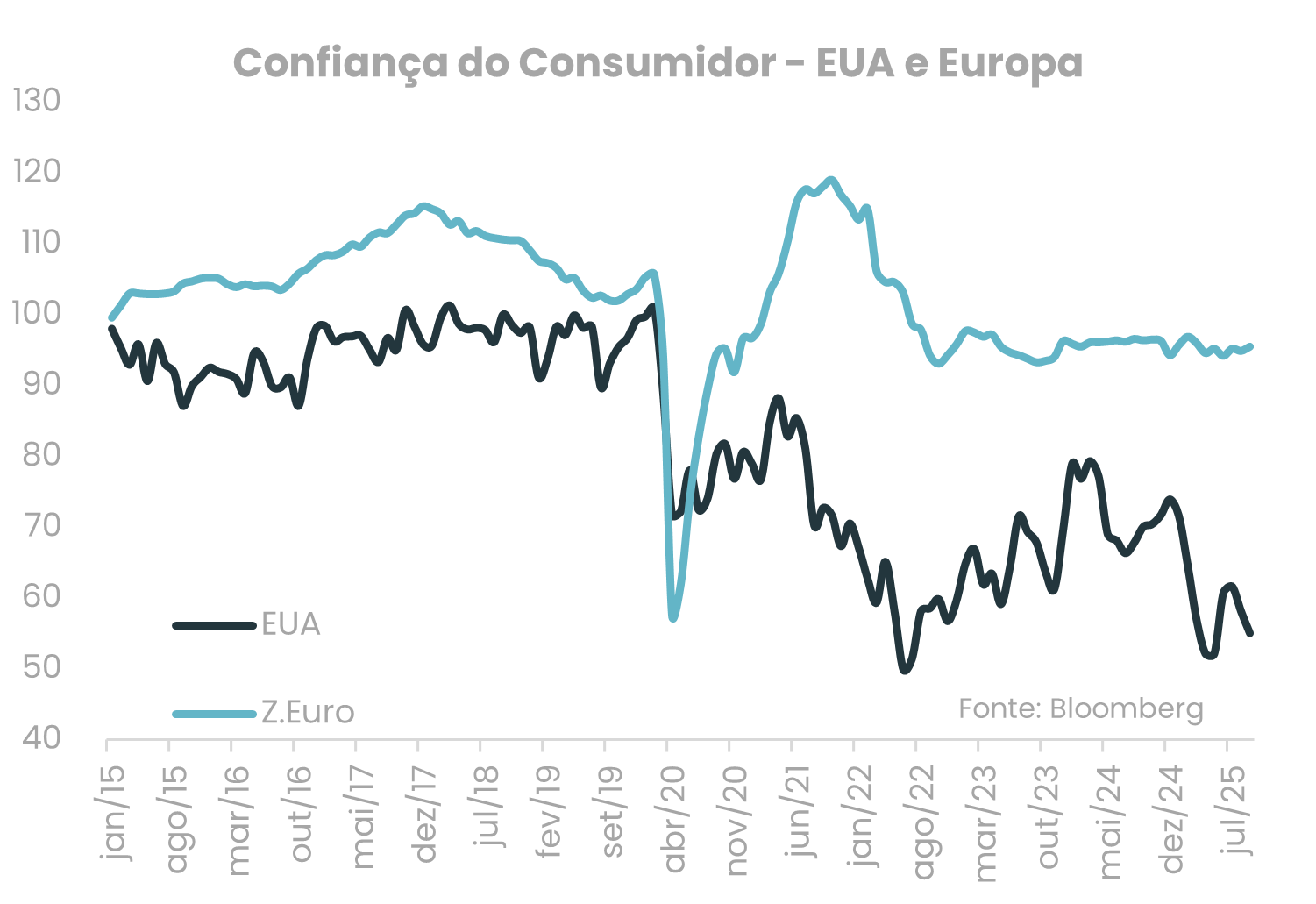
Furthermore, it is worth noting that in the main advanced economies, the scenario is still one of distrust. Both in the Eurozone and in the United States, confidence indices remain below the levels observed before the pandemic (see chart). The high cost of credit, even with the start of the interest rate cut cycle, still limits the appetite for consumption and investment. It is expected that more accommodative monetary policy—especially after the recent interest rate cuts by the Federal Reserve and the European Central Bank—will contribute to a more consistent recovery of confidence indicators in the coming months.
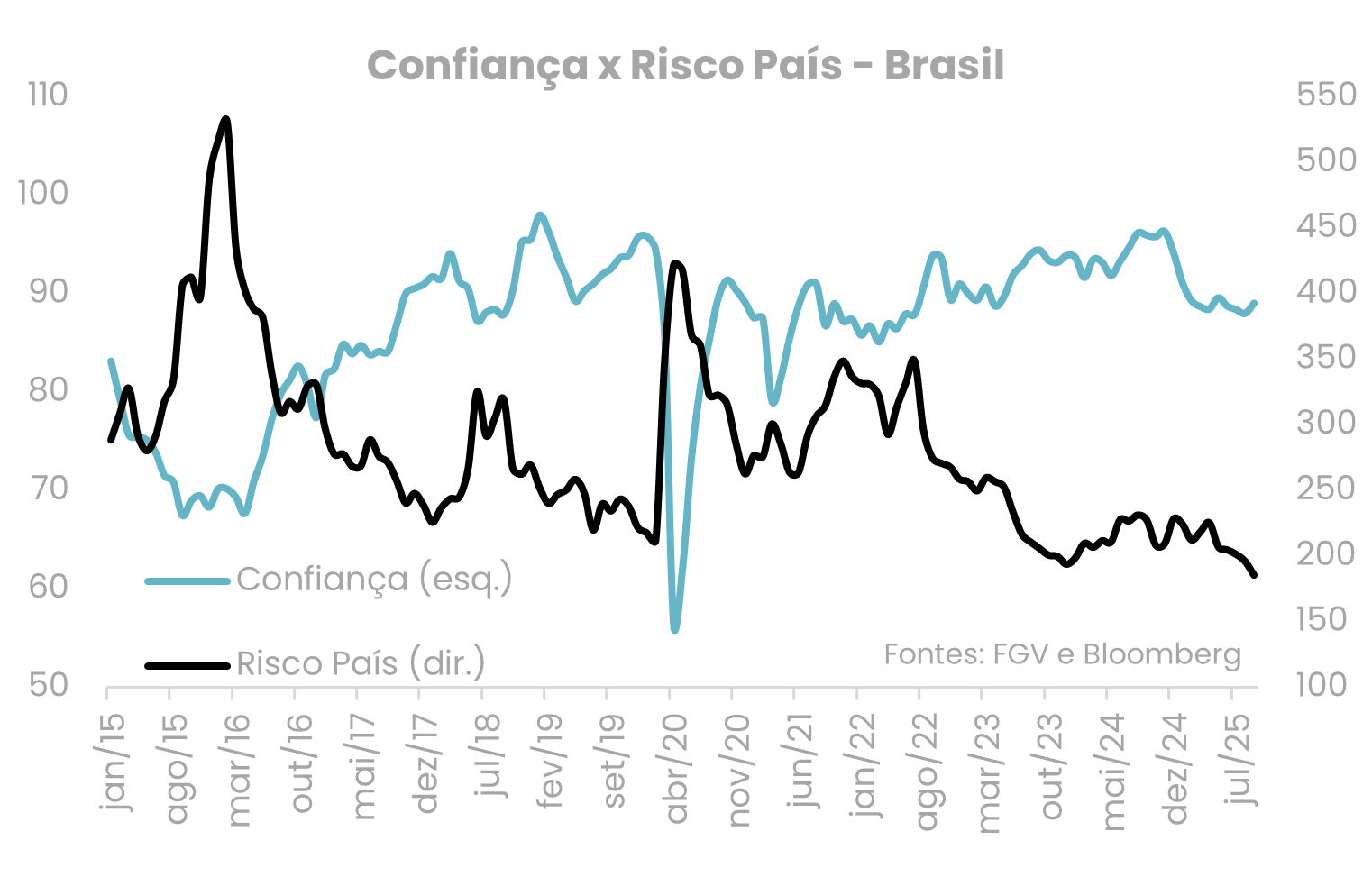
Beyond being a thermometer for economic mood, confidence exerts influence over key variables such as country risk and the exchange rate. Historically, both move in opposite directions: when confidence increases, risk decreases—and vice versa. In the Brazilian case, however, this pattern has proven less predictable. Despite the improvement in confidence indicators, country risk has remained at practically the same level for a year (see chart), reflecting concern over the fiscal situation and uncertainty regarding the political environment—read: the approach of the 2026 election race. This divergence shows that, although confidence is an important signal, it is not enough to anchor expectations amidst so many doubts. It is still too early to say whether the recent optimism will be lasting or if it will yield to fiscal and electoral challenges. After all, confidence is essential—but too much confidence, in delicate moments, can lead to hasty decisions.
Conclusion: For now, what we are observing is a country in a holding pattern: cautious, but not paralyzed. What comes next will depend on how fiscal and monetary policies are conducted, and how consumers and businesses interpret these signals. In times of uncertainty, more than ever, measuring confidence is also measuring the economy's level of patience.

A summary of the main events of each day that may influence the exchange rate, all in less than 1 minute.
Listen nowThe Ouribank Group does not offer loans, credit or debit cards, and does not request or take responsibility for payments of bank slips or deposits into current accounts held by beneficiaries other than Ouribank S.A. Banco Múltiplo and Ouribank Group companies.
Be alert to any unusual practices for credit approval, such as advance payments. Be suspicious of emails that do not come from Ouribank, for example: @outlook, @gmail, @hotmail, etc., or messages via WhatsApp, Facebook, Instagram, and Telegram, or calls from third parties.
If you have any questions, please contact us at: 0800-771-4342 or (11) 4081-4444


Ouribank
CNPJ No. 78,632,767/0001-20 Ouribank Building
Av. Paulista, No. 1,728 - overstore, 1st, 2nd, 3rd, 4th, 5th, 7th and 11th floors
Bela Vista Zip Code - 01310-919
São Paulo - SP
Phone: (11) 4081-4444
Hearing Impaired Care:
(11) 3171-3003
P
Tamer Comunicação Empresarial
+ 5511 99602-1317
Gustavo Girotto
gugirotto@tamer.com.br
Ana Carolina Saito ana.saito@tamer.com.br

Social Media