About us

Solutions
Products
Content


Por
As if the year-end recaps from Spotify, Strava (my personal favorite!), Netflix, and Google—which provide us with lists of our most-played songs, miles covered, and favorite movies, series, and routes—weren't enough, 2025 also delivered its own macroeconomic "playlist," complete with hits, surprises, and a few tracks no one wanted to hear to the end. At the start of the year, the projections from the Focus Report painted a relatively balanced picture: GDP would grow by about 2.0%, the IPCA would end the year near 5.0%, the Selic rate would remain high at 15% throughout the year, and the exchange rate would hover at more depreciated levels, around R$6.00 per USD. So, when the playlist reached its end, the expectation was for an economy in controlled deceleration, trying to adjust to a still-challenging global environment, but without any major disruptions. But was that really how it played out? See the table below.
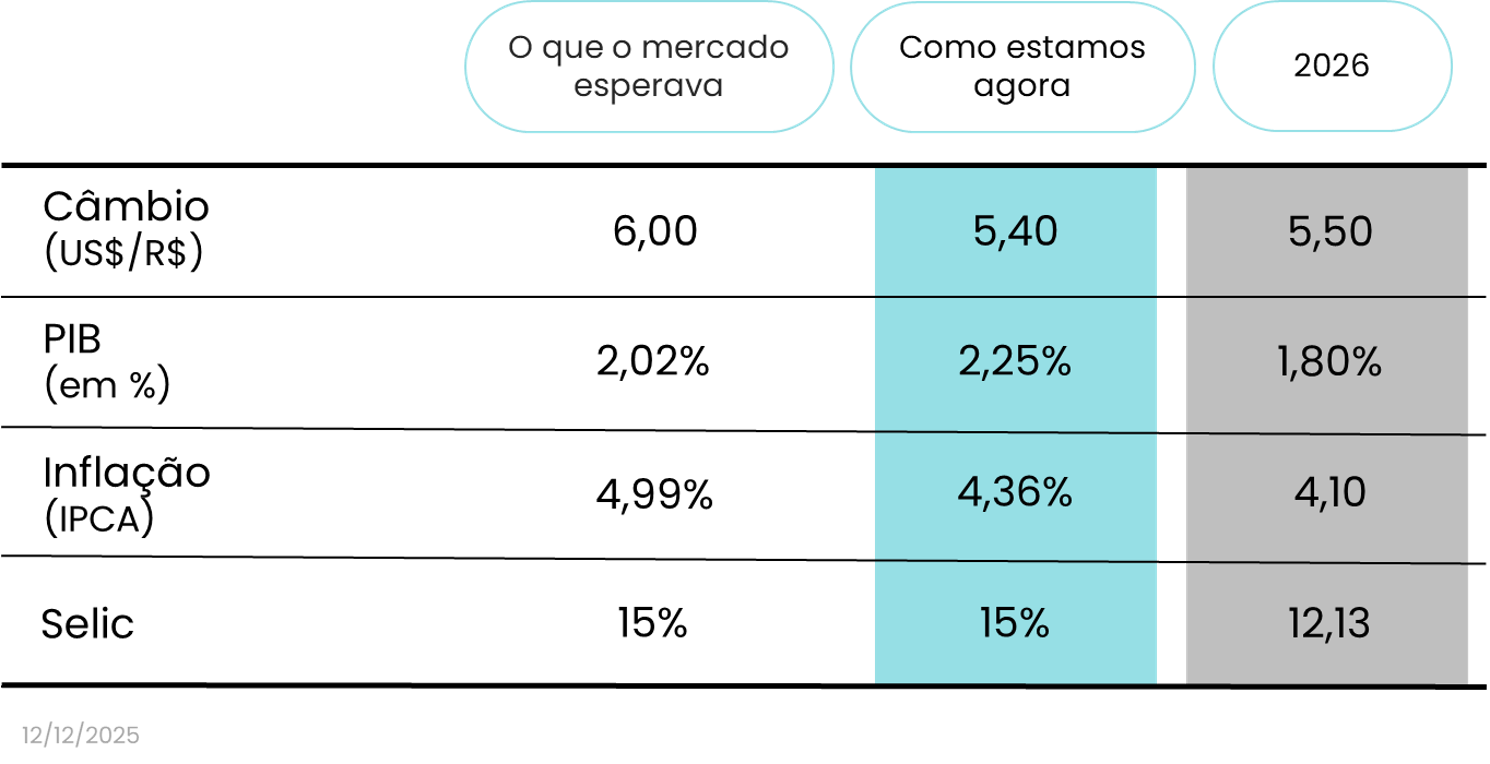
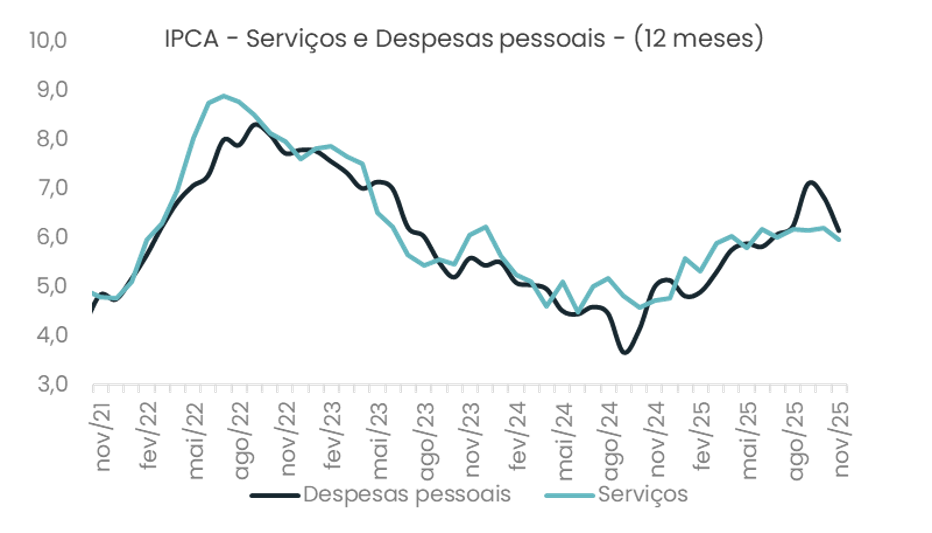
Over the months, however, some tracks received new arrangements. Consumer inflation, while showing resilience in services and items sensitive to supply shocks (those subject to weather variations, international costs, or production bottlenecks), ended up surprising on the upside in the aggregate (see chart). Revisions throughout the year brought the IPCA projection down to 4.36% in the latest Focus Report from the Central Bank, lower than what was expected in January—a significant improvement, though not enough to completely dispel concerns about convergence to the 3.0% target midpoint. The disinflationary process did occur, but it required more patience than many models suggested at the beginning of the year.
In monetary policy, the script was less flexible. Unlike initial bets that interest rate cuts might gain traction throughout 2025, the Selic rate and projections remained at 15% per year for the entire period. This behavior reflected the still-uncomfortable inflation picture mentioned above and the need to preserve the credibility of the monetary regime, reinforcing the view that the Central Bank chose to maintain a more cautious stance, even in the face of occasional signs of improvement.
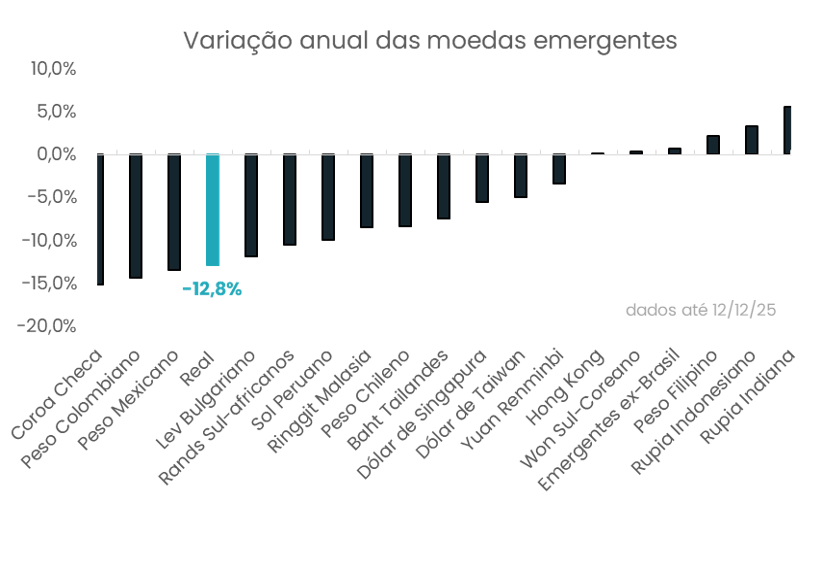
The exchange rate, for its part, was one of the most favorable tracks on this playlist. The rate projected at R$6.00 per USD at the start of the year was revised to R$5.40, and we believe it could dip even further by the end of this month. The performance was better than expected, even if marked by episodes of high volatility. This movement primarily reflected the global loss of strength of the dollar throughout the year (see chart), in an environment of greater caution regarding the U.S. economy, reinforced by signs of slowing activity. Furthermore, uncertainties surrounding the conduct of U.S. economic and tariff policy reduced the dollar's attractiveness as a safe-haven asset. The still-high interest rate differential in Brazil and the flow into emerging markets helped support the real, even in a scenario punctuated by political and fiscal noise.
Finally, economic growth was perhaps the biggest "off-script hit." GDP, initially projected at 2.02%, was revised upward throughout the year to reach 2.25%, reflecting more resilient economic activity, especially in the services and consumption sectors. In a context of restrictive monetary policy (i.e., high interest rates), this result reinforced the perception that the Brazilian economy found more momentum than was imagined at the beginning of 2025.
In summary, the macroeconomic retrospective of the year shows a better balance than anticipated in January: stronger growth, and inflation and exchange rates at more benign levels, even with persistently high interest rates.
Looking ahead to 2026, the scenario points to inflation on a path of gradual deceleration toward the target midpoint, albeit subject to some bumps along the way. Interest rates should end the year at a lower level than in 2025, but with a slow and cautious easing process. For the exchange rate, the trend is one of slight depreciation, reflecting the typical environment of an election year, marked by greater volatility and sensitivity to political noise. Economic growth, in turn, tends to feel the lagged effects of restrictive monetary policy more clearly, resulting in more moderate and less resilient expansion. This combination reinforces the need for coordination between monetary credibility, fiscal policy, and confidence so that the economy can deliver more than just one-off performances. If 2025 was a "mixtapeof adjustments and surprises, 2026 will demand a more cohesive album — with the market paying close attention to the quality of execution, track by track.

A summary of the main events of each day that may influence the exchange rate, all in less than 1 minute.
Listen nowThe Ouribank Group does not offer loans, credit or debit cards, and does not request or take responsibility for payments of bank slips or deposits into current accounts held by beneficiaries other than Ouribank S.A. Banco Múltiplo and Ouribank Group companies.
Be alert to any unusual practices for credit approval, such as advance payments. Be suspicious of emails that do not come from Ouribank, for example: @outlook, @gmail, @hotmail, etc., or messages via WhatsApp, Facebook, Instagram, and Telegram, or calls from third parties.
If you have any questions, please contact us at: 0800-771-4342 or (11) 4081-4444


Ouribank
CNPJ No. 78,632,767/0001-20
Ouribank Building
Av. Paulista, No. 1,728 - overstore, 1st, 2nd, 3rd, 4th, 5th, 7th and 11th floors
Bela Vista Zip Code - 01310-919
São Paulo - SP
Phone: (11) 4081-4444
Hearing Impaired Care:
(11) 3171-3003
P
Tamer Comunicação Empresarial
+ 5511 99602-1317
Gustavo Girotto
gugirotto@tamer.com.br
Ana Carolina Saito ana.saito@tamer.com.br

Social Media