About us

Solutions
Products
Content


Por
What should we expect from the long-awaited and well-known year-end dollar outflow in Brazil? As the year draws to a close, the Brazilian economy enters a period where seasonal factors and the strategic decisions of companies and investors converge, creating a typical and familiar movement in the financial market: the outflow of dollars from the country. Although this topic often appears in the news with an air of concern, much of this flow is actually recurring and predictable. December is marked by import settlements, profit and dividend remittances by multinationals, and portfolio adjustments by global funds rebalancing their holdings before the fiscal year ends. All of this generates additional demand for foreign currency and puts pressure on our exchange rate, often resulting in a temporary appreciation of the dollar against the real.
At the same time, foreign investors tend to reduce their exposure to emerging markets during this time of year, seeking lower volatility and higher liquidity to close out the year with more conservative positions. Since Brazil is still viewed as a market sensitive to political and fiscal factors—as we know all too well—any additional noise amplifies the perception of risk, leading some of these investors to adopt a more cautious stance. This behavior can intensify capital outflows in the very short term, creating a combination that may seem alarming at first glance, but is, in practice, part of the global financial calendar.
The key is to understand that exchange rate dynamics are not limited to the specific behavior of December. What truly defines the dollar's path in the following months is the set of macroeconomic fundamentals: interest rate trajectories in Brazil and the United States, fiscal credibility, foreign direct investment flows, growth expectations, and geopolitical scenarios. If the Central Bank of Brazil maintains a monetary policy capable of attracting foreign capital—through competitive real interest rates—and if the government provides clear signals of fiscal responsibility, the country tends to recover part of the dollar flow as early as the beginning of the following year. On the other hand, internal uncertainties or a more risk-averse external environment could prolong the period of exchange rate pressure. In this sense, I believe we are neither here nor there. While the Brazilian real interest rate is indeed attractive, we lack signals regarding the future of fiscal accounts—or rather, the signals we do have are not the best, which contributes to adding volatility to this scenario.
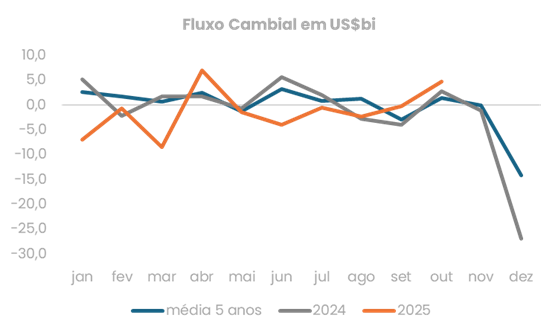
To give you an idea, looking at exchange flow data, there has been an average dollar outflow of about $14 billion over the last five years. Last year, we saw an outflow of more than $25 billion (see chart), when the US currency rate soared to a record level of R$ 6.30. But we know that this was not the only reason for the exchange rate pressure at the end of last year, as we also had the Trump factor. For this year, the Central Bank itself has signaled in some communications that it "does not expect stress similar to that observed last year," as this year's conditions, when compared to 2024, appear more favorable. The discussion regarding the Brazilian fiscal framework seems to have been pushed to 2027; uncertainties like the Trump administration are reduced, and the Brazilian presidential election tends to influence asset behavior more significantly only starting in March or April of next year.
Still, it is important to highlight that these movements are like tides: they rise, they fall, sometimes they surprise, but they follow a pattern that the market understands. This helps explain why, despite the volatility, analysts and investors are able to anticipate trends without resorting to dramatic predictions. The year-end dollar outflow is almost a recurring character in the Brazilian market—it makes noise and drives the plot, but it rarely changes the structural direction of the story. What comes next depends more on the consistency of economic policies than on the "calendar effect."
In short, investors or those observing the exchange rate should face this moment with attention, but also with perspective. December is usually turbulent, but January opens up space for readjustment, the inflow of new resources, and the resumption of global investment decisions—and in 2026, with an important impact factor called the Brazilian presidential election. Thus, the economy should follow its narrative and, as always, the dollar will continue to be that emotional protagonist that loves a plot twist, but responds, at the end of the day, to the logic of fundamentals. Sometimes, not even that much!

A summary of the main events of each day that may influence the exchange rate, all in less than 1 minute.
Listen nowThe Ouribank Group does not offer loans, credit or debit cards, and does not request or take responsibility for payments of bank slips or deposits into current accounts held by beneficiaries other than Ouribank S.A. Banco Múltiplo and Ouribank Group companies.
Be alert to any unusual practices for credit approval, such as advance payments. Be suspicious of emails that do not come from Ouribank, for example: @outlook, @gmail, @hotmail, etc., or messages via WhatsApp, Facebook, Instagram, and Telegram, or calls from third parties.
If you have any questions, please contact us at: 0800-771-4342 or (11) 4081-4444


Ouribank
CNPJ No. 78,632,767/0001-20 Ouribank Building
Av. Paulista, No. 1,728 - overstore, 1st, 2nd, 3rd, 4th, 5th, 7th and 11th floors
Bela Vista Zip Code - 01310-919
São Paulo - SP
Phone: (11) 4081-4444
Hearing Impaired Care:
(11) 3171-3003
P
Tamer Comunicação Empresarial
+ 5511 99602-1317
Gustavo Girotto
gugirotto@tamer.com.br
Ana Carolina Saito ana.saito@tamer.com.br

Social Media