About us

Solutions
Products
Content


Por
CAUSE: The caution dominating global markets continues to be fueled by a set of overlapping and mutually reinforcing uncertainties. Geopolitical tensions in the Middle East remain high, putting pressure on oil prices, reigniting inflationary concerns, and adding volatility to global assets. It is in this environment that investor attention turns to the so-called "Super Wednesday," when monetary policy decisions occur simultaneously in Brazil and the United States. In the U.S., the prevailing expectation is for the Federal Reserve to hold rates steady, currently in the 3.50% to 3.75% range, as the central bank assesses the impact of inflation and geopolitical uncertainties on the rate-cut cycle projected for 2026. In Brazil, meanwhile, expectations are growing for the start of a monetary easing cycle, with the market divided between a 0.25 p.p. or 0.50 p.p. cut to the Selic rate, currently at 15% per year, following months of rates held at restrictive levels to ensure inflation converges to the target. In short, the global landscape remains marked by known uncertainties—stubborn inflation, geopolitical tensions, and doubts about the pace of economic activity—but now with an additional element: the need to calibrate expectations for the start of monetary easing in Brazil and the pause in the rate-cut cycle in the U.S.
CONSEQUENCE: Faced with this cloudier environment, markets tend to adopt a defensive stance. Investors are reducing exposure to higher-risk assets and strengthening positions in instruments considered safer and more liquid, which increases volatility in equity markets and international capital flows. In general, this flight to safety tends to strengthen the dollar globally. However, the real continues to find some support in the still-high interest rate differential, which keeps Brazil relatively attractive in the fixed-income universe. Thus, tomorrow's decisions—and, above all, the tone of the communications from the Fed and the Copom—will be fundamental in calibrating expectations regarding the interest rate differential, capital flows, and, consequently, the trajectory of the exchange rate in the coming weeks.
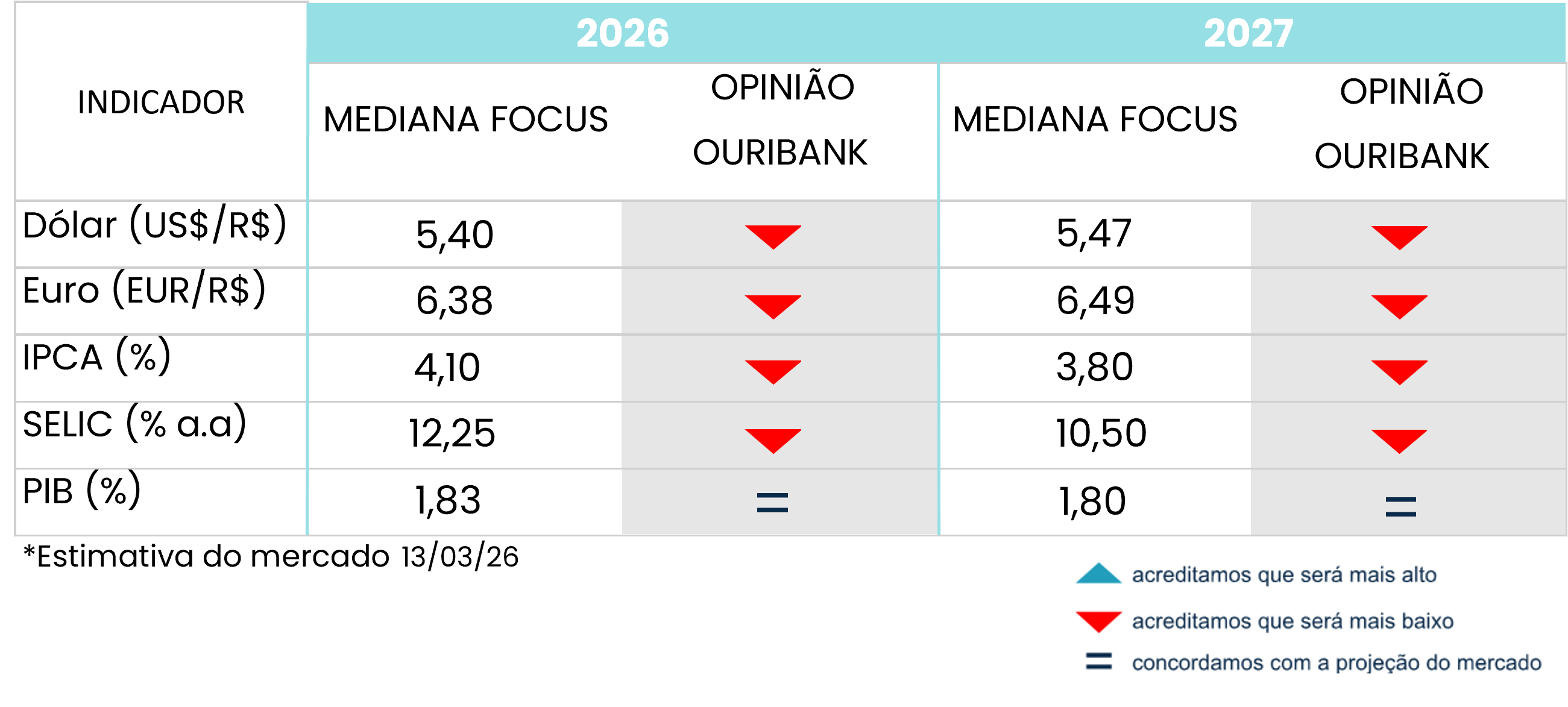

A summary of the main events of each day that may influence the exchange rate, all in less than 1 minute.
Listen nowThe Ouribank Group does not offer loans, credit or debit cards, and does not request or take responsibility for payments of bank slips or deposits into current accounts held by beneficiaries other than Ouribank S.A. Banco Múltiplo and Ouribank Group companies.
Be alert to any unusual practices for credit approval, such as advance payments. Be suspicious of emails that do not come from Ouribank, for example: @outlook, @gmail, @hotmail, etc., or messages via WhatsApp, Facebook, Instagram, and Telegram, or calls from third parties.
If you have any questions, please contact us at: 0800-771-4342 or (11) 4081-4444


Ouribank
CNPJ No. 78,632,767/0001-20
Ouribank Building
Av. Paulista, No. 1,728 - overstore, 1st, 2nd, 3rd, 4th, 5th, 7th and 11th floors
Bela Vista Zip Code - 01310-919
São Paulo - SP
Phone: (11) 4081-4444
Hearing Impaired Care:
(11) 3171-3003
P
Tamer Comunicação Empresarial
+ 5511 99602-1317
Gustavo Girotto
gugirotto@tamer.com.br
Ana Carolina Saito ana.saito@tamer.com.br

Social Media