About us

Solutions
Products
Content


Por
CAUSE: The outlook for the coming days appears cautious, with investors becoming more selective in the face of global uncertainty. Developments surrounding the meeting between the United States and Ukraine add a significant geopolitical layer, while the Jackson Hole symposium is drawing attention as investors look for clearer signals from the Fed chair regarding the next steps for U.S. monetary policy. A more hawkish tone from the U.S. central bank could strengthen the dollar and put pressure on emerging market currencies, while signs of greater flexibility would provide some temporary relief. In Brazil, beyond these external factors, markets will be monitoring statements from the Central Bank president, which could shift bets on the local interest rate trajectory, as well as the weaker IBC-Br reading—a key activity indicator—and trade negotiations with the U.S. regarding tariffs, all of which could influence not only investor sentiment but also the short-term performance of the real.
CONSEQUENCE: This cautious environment is likely to result in increased volatility for Brazil's key macroeconomic variables. The exchange rate may experience sharper fluctuations, influenced by both signals from the Fed and geopolitical uncertainties, which directly impacts inflation expectations. This situation, in turn, could lead to revisions in domestic monetary policy projections, as the Central Bank will need to calibrate its communication in response to potential external pressures. Furthermore, the IBC-Br reading may carry additional weight in shaping growth expectations, while any progress or setbacks in trade negotiations with the U.S. are likely to influence investor sentiment and, ultimately, the appetite for Brazilian assets.
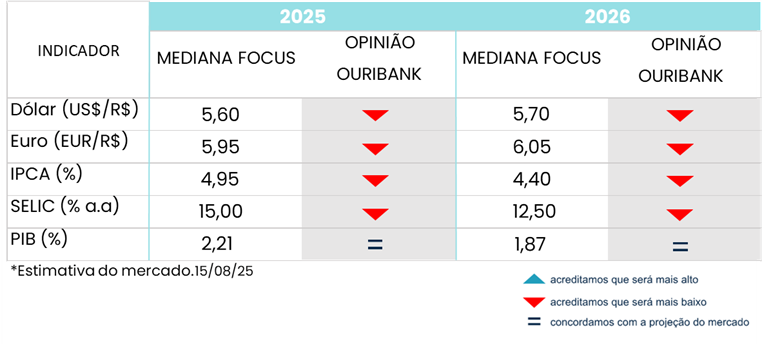

A summary of the main events of each day that may influence the exchange rate, all in less than 1 minute.
Listen nowThe Ouribank Group does not offer loans, credit or debit cards, and does not request or take responsibility for payments of bank slips or deposits into current accounts held by beneficiaries other than Ouribank S.A. Banco Múltiplo and Ouribank Group companies.
Be alert to any unusual practices for credit approval, such as advance payments. Be suspicious of emails that do not come from Ouribank, for example: @outlook, @gmail, @hotmail, etc., or messages via WhatsApp, Facebook, Instagram, and Telegram, or calls from third parties.
If you have any questions, please contact us at: 0800-771-4342 or (11) 4081-4444


Ouribank
CNPJ No. 78,632,767/0001-20 Ouribank Building
Av. Paulista, No. 1,728 - overstore, 1st, 2nd, 3rd, 4th, 5th, 7th and 11th floors
Bela Vista Zip Code - 01310-919
São Paulo - SP
Phone: (11) 4081-4444
Hearing Impaired Care:
(11) 3171-3003
P
Tamer Comunicação Empresarial
+ 5511 99602-1317
Gustavo Girotto
gugirotto@tamer.com.br
Ana Carolina Saito ana.saito@tamer.com.br

Social Media