About us

Solutions
Products
Content

By
Michele Loureiro
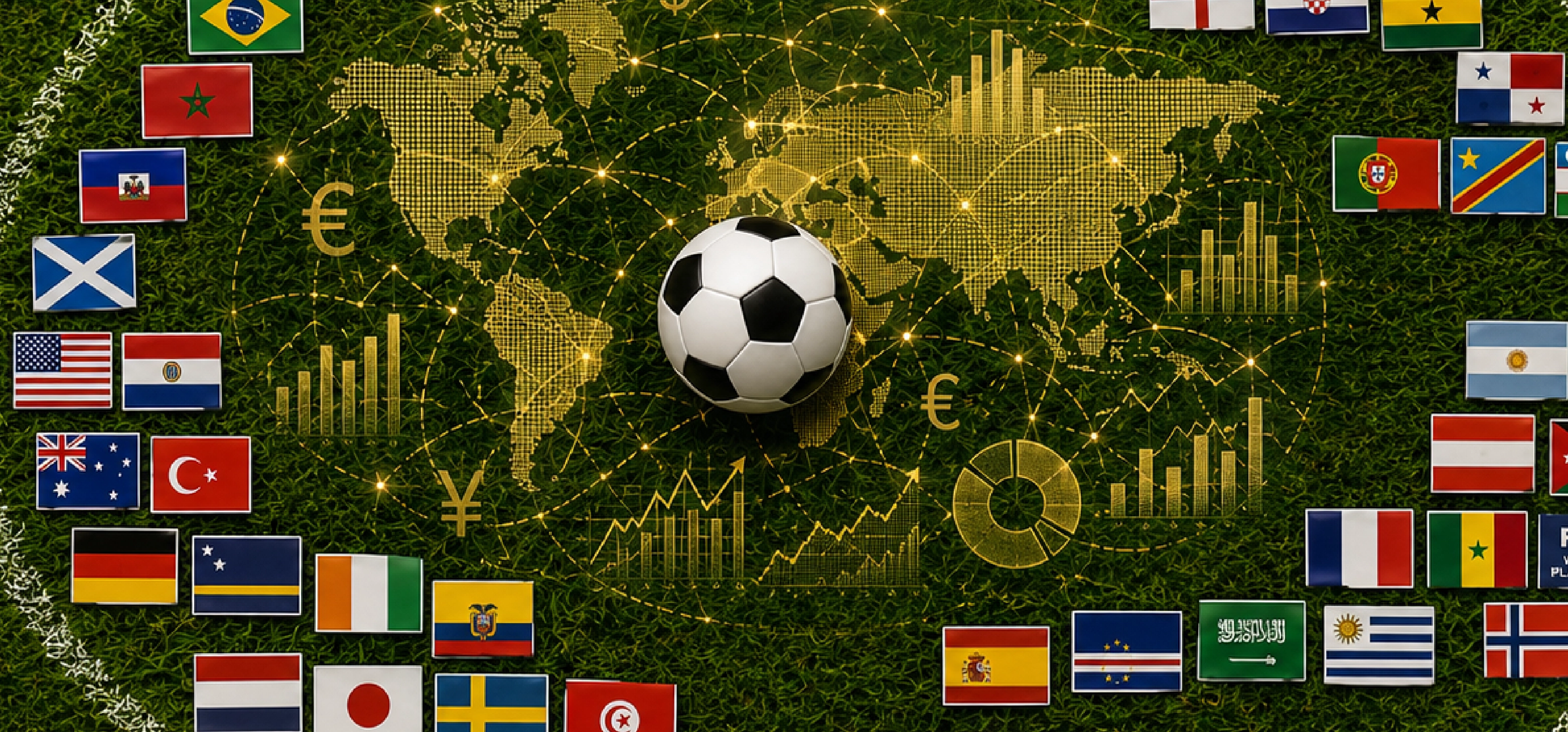
With the World Cup just days away, scheduled for June 11, governments, companies, and investors are turning their attention to one of the biggest events on the planet. Far beyond football, the tournament drives entire chains of tourism, transport, retail, advertising, technology, and services, creating effects that cross borders, reach different sectors of the economy, and even impact foreign exchange.
Projections help to gauge this scale. Studies linked to FIFA estimate that the 2026 World Cup could generate more than $40 billion in global Gross Domestic Product (GDP), attract around 6.5 million visitors, and drive nearly $14 billion in tourism spending. The expectation is that the competition will contribute to the creation of more than 800,000 jobs across different countries and economic sectors.
The benefits, however, are not distributed evenly. As hosts of the tournament, the United States, Canada, and Mexico tend to concentrate the largest gains, driven by increased tourist flow, consumption of services, and investments made to meet the demand generated by the event.
In addition to the effects on these sectors, the World Cup also tends to generate ripples in financial markets, especially in host countries. The increase in visitor arrivals, international spending, and foreign currency circulation tends to temporarily strengthen demand for local currency and boost economic activity in sectors directly linked to the event.
According to Cristiane Quartaroli, chief economist at Ouribank, these movements are usually more noticeable in host countries and rarely cause structural changes in the markets. “The most relevant effect usually appears in local currencies, through the inflow of foreign exchange and greater demand for domestic currency. In general, the financial market absorbs these movements without major structural distortions,” she says.
This is because the World Cup is widely anticipated by investors, companies, and governments. Unlike geopolitical crises, abrupt changes in economic policy, or unexpected shocks, its effects are usually already incorporated into expectations long before the matches begin. Even so, the competition helps to illustrate an increasingly important characteristic of today's economy: the speed with which international events can influence markets, costs, and business strategies.
In recent years, Brazilian companies have had to deal with a succession of factors capable of altering revenues, expenses, and investment decisions in a matter of weeks. The pandemic, international conflicts, the reorganization of global production chains, high inflation, and more aggressive interest rate cycles have increased risk perception and demanded greater sophistication in financial management.
This shift has had a direct impact on how exporters and importers handle foreign exchange. “Planning revenue or costs in dollars without a currency hedging policy is no longer an acceptable option. Today, more mature companies work with longer protection windows, currency diversification, and constant monitoring of the external landscape,” says Quartaroli.
This shift is particularly relevant for sectors that deal with dollar-denominated costs on a daily basis, such as air transport, logistics, and the import of raw materials. In these segments, currency fluctuations can affect margins, competitiveness, and planning capacity almost immediately.
However, the need for preparation extends beyond companies directly involved in foreign trade. In a globalized environment, events occurring in different parts of the world can influence prices, production costs, supply chains, and investment decisions across virtually every sector of the economy.
The dynamics of inflation itself help illustrate this phenomenon. In a recent report, Ouribank highlighted that some of the price pressures observed throughout 2026 were fueled by external factors, such as the escalation of the conflict in the Middle East, which drove up oil prices and ultimately affected fuel, freight, and logistics costs across various economic activities. This episode shows how events taking place thousands of miles away can quickly impact the budgets of Brazilian companies and consumers.
In this context, the main lesson from a competition like the World Cup may not lie in the temporary effects it triggers, but in the importance of planning. Just as countries, sponsors, and organizers spend years preparing for an event of this scale, companies exposed to the international market must build mechanisms capable of weathering periods of greater instability without relying on decisions made under pressure.
“Well-prepared companies have currency policies defined before the turbulence arrives. They don’t react to the scenario; they anticipate it and prepare for it,” the economist states. This preparation ranges from currency hedging instruments to access to reliable information, constant monitoring of the economic environment, and the ability to translate analysis into decision-making. “In volatile environments, the advantage lies in not having to make important decisions under pressure,” says Quartaroli.
The World Cup lasts for a few weeks. Its most visible impacts on tourism, consumption, and economic activity also tend to be temporary. However, the factors that truly shape the business environment—inflation, interest rates, exchange rates, geopolitics, and international trade—remain on the field all year round.

A summary of the main events of each day that may influence the exchange rate, all in less than 1 minute.
Listen nowThe Ouribank Group does not offer loans, credit or debit cards, and does not request or take responsibility for payments of bank slips or deposits into current accounts held by beneficiaries other than Ouribank S.A. Banco Múltiplo and Ouribank Group companies.
Be alert to any unusual practices for credit approval, such as advance payments. Be suspicious of emails that do not come from Ouribank, for example: @outlook, @gmail, @hotmail, etc., or messages via WhatsApp, Facebook, Instagram, and Telegram, or calls from third parties.
If you have any questions, please contact us at: 0800-771-4342 or (11) 4081-4444


Ouribank
CNPJ No. 78,632,767/0001-20 Ouribank Building
Av. Paulista, No. 1,728 - overstore, 1st, 2nd, 3rd, 4th, 5th, 7th and 11th floors
Bela Vista Zip Code - 01310-919
São Paulo - SP
Phone: (11) 4081-4444
Hearing Impaired Care:
(11) 3171-3003
P
Tamer Comunicação Empresarial
+ 5511 99602-1317
Gustavo Girotto
gugirotto@tamer.com.br
Ana Carolina Saito ana.saito@tamer.com.br

Social Media